Consent

This site uses third party services that need your consent. Learn more

Skip to content
EX
VAT
INC
VAT
Shop now
Login

Article

Can Infrared Heating Be Used Outdoors?

Yes, infrared is one of the few forms of electric heating genuinely suited to outdoor use. But “suited to outdoor use” is not the same as “works anywhere, at any output, mounted however you like”. The difference between an outdoor space that feels comfortable and one where the heater seems to do very little usually comes down to specification: how exposed the space is, where and how high the heaters are mounted, and whether the warmth is directed at the people actually using the space. 

This guide explains how infrared behaves outdoors, what affects its performance, roughly what it costs to run, and how to choose equipment for patios, terraces, hospitality areas and workplaces.

Why Infrared Works Outdoors When Air Heating Doesn't 

Most conventional heating works by warming the air, and warm air is the first thing an outdoor space loses. Open one side of a terrace to the garden, or let a breeze move through a beer garden, and heated air is carried away almost as quickly as it is produced. 

Infrared heaters work on a different principle. They transfer radiant energy directly to people, furniture and surfaces in their path, in much the same way that you feel the sun's warmth on a cool day. Because the heat does not depend on warming and containing a volume of air, infrared remains effective in open and partially open spaces where air heating is largely futile. 

It is worth being accurate about this rather than overstating it. Infrared does not make wind irrelevant, a strong, cold wind still draws heat away from skin and clothing, so exposed spaces need more radiant intensity to feel comfortable than sheltered ones. The advantage is that infrared's effectiveness does not rely on trapping warm air in the first place, which is exactly the condition outdoor spaces cannot meet. 

What Determines How Well Infrared Performs Outdoors 

Two identical heaters can produce very different levels of comfort in different settings. When we assess an outdoor space, these are the factors that matter most. 

Exposure and wind

A covered terrace with two or three sides sheltered behaves very differently from a fully open patio. The more exposed the space, and the windier the site, the more radiant output is needed for the same feeling of warmth. Screens, canopies and planting that reduce wind speed all improve comfort without adding a single watt.

Mounting height and angle

Radiant intensity falls away with distance, so a heater mounted too high can be working hard while the people below feel little of it. Equally, a powerful heater mounted too low can feel uncomfortably intense directly beneath it. Mounting height, tilt angle and the heater's beam characteristics need to be matched to the seating or standing positions below.

The area you actually need to cover

A single large heater rarely covers a wide area evenly. It is often better to use several smaller units positioned around the space than one powerful unit in the middle, particularly over long runs of seating.

Whether people are seated or moving

Seated diners stay in one place for an hour or more and notice cold quickly, so they need consistent, well-aimed coverage. People standing at a smoking shelter or passing through a doorway are typically served well by more concentrated, shorter-duration warmth.

How often, and for how long, the space is used

A patio used for a few evenings a week has different priorities from a pub garden in use every trading day through autumn and winter. Usage pattern affects the case for better controls, zoning and higher-specification equipment.

IP rating

Every electrical product carries an IP (ingress protection) rating indicating its resistance to dust and water. A heater under a solid canopy faces different conditions from one on an open wall exposed to driving rain. Always match the IP rating to the actual location, not simply to the word “outdoor” on the box. Exposure and wind A covered terrace with two or three sides sheltered behaves very differently from a fully open patio. The more exposed the space, and the windier the site, the more radiant output is needed for the same feeling of warmth. Screens, canopies and planting that reduce wind speed all improve comfort without adding a single watt.

Why Zoned Outdoor Heating Matters 

In most outdoor applications there is no reason to try to heat the whole space. Nobody needs the middle of the lawn to be warm. What matters is the table people are sitting at, the bench outside the back door, or the row of seats along the terrace. 

Because infrared is directional, it lends itself naturally to zoning: positioning heaters so that warmth lands where people actually are, and controlling each zone independently. A restaurant can run heaters only over occupied tables; a workplace can heat the break area only during breaks. Zoning is usually the single biggest factor in keeping outdoor running costs sensible, because unoccupied areas simply cost nothing. 

Where Outdoor Infrared Heating Works Well 

Domestic patios and terraces.

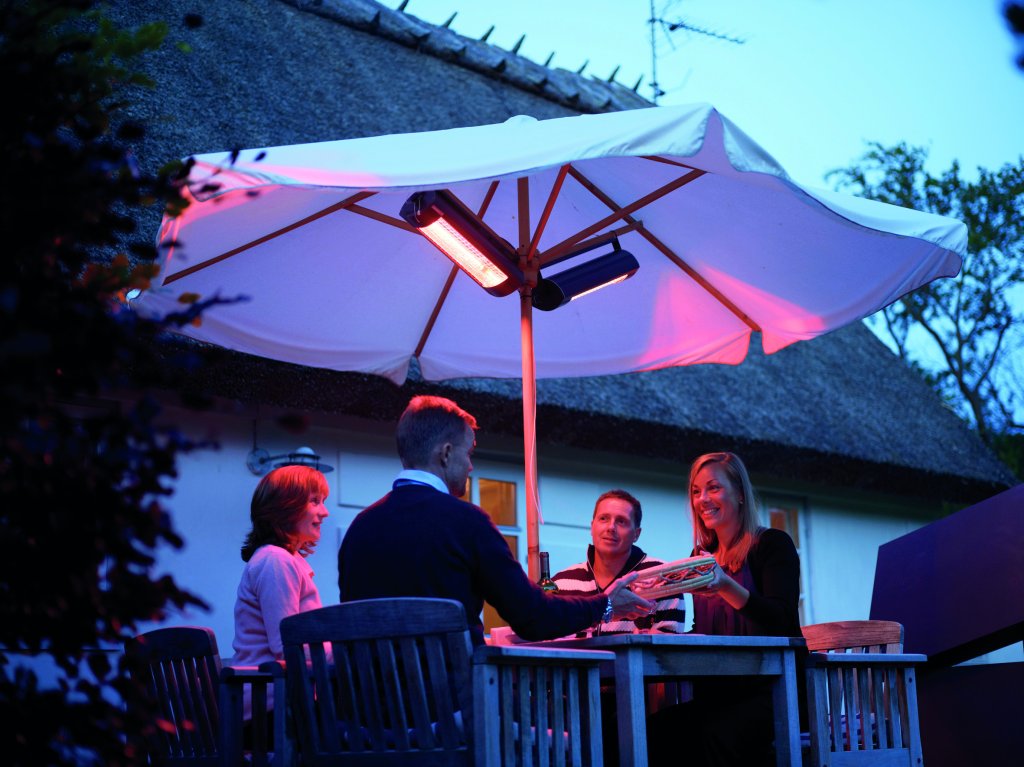
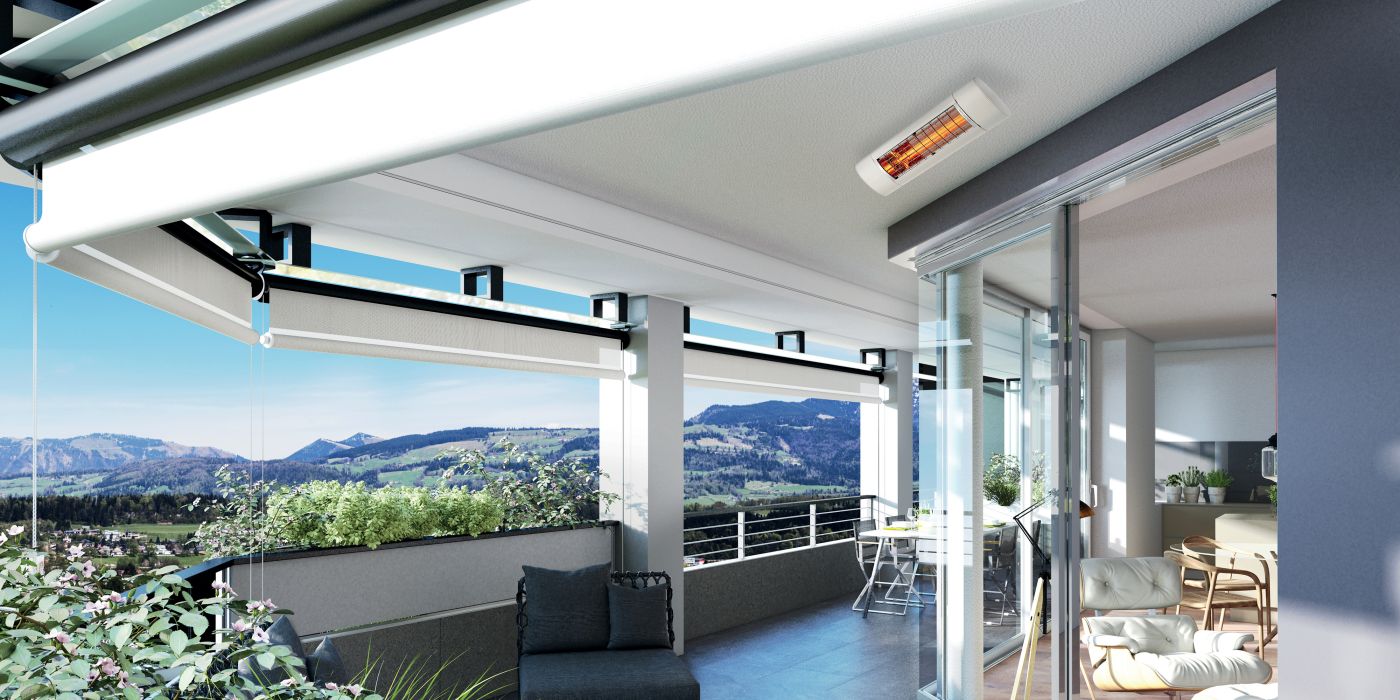
Wall or pergola mounted heaters extend the usable season for outdoor dining and evening seating without the storage, refilling and clutter of gas patio heaters. 

Pubs, restaurants and cafés.

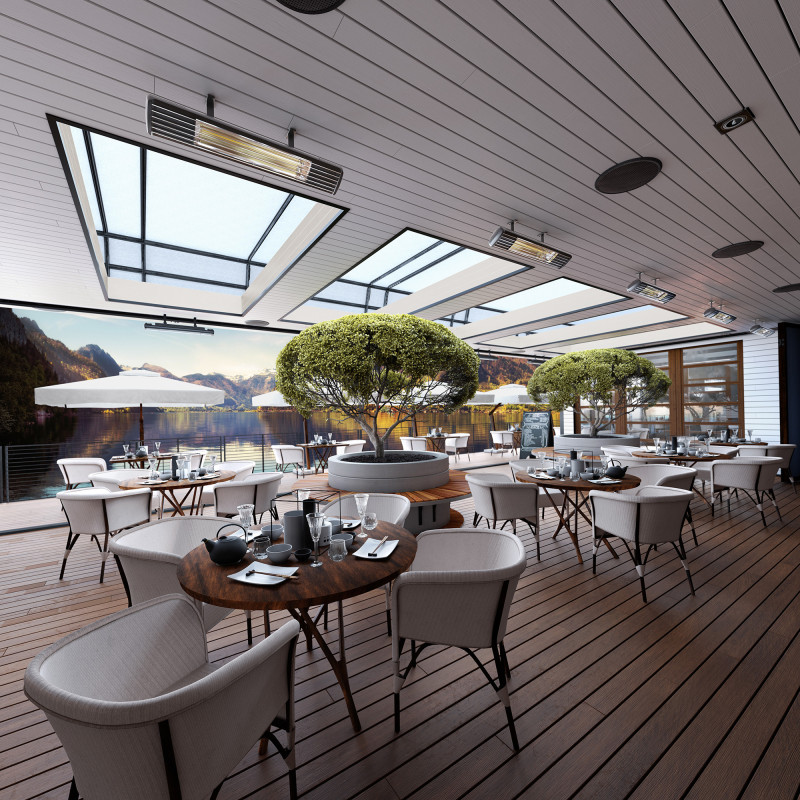
Comfortable outdoor seating directly affects covers and revenue in the shoulder seasons. Well-zoned infrared lets hospitality venues keep terraces and gardens trading later into the year, with heat concentrated over tables rather than wasted on empty space. 

Outdoor workplace and break areas.

Smoking shelters, loading canopies and external break areas can be made comfortable for staff with targeted heaters on simple controls, such as push-button run-back timers. 

Events and hospitality spaces.

Marquees, courtyards and semi-open venues benefit from heat that works the moment it is switched on and does not depend on enclosing the space. 

A Word About Glare 

Not all infrared heaters look the same in operation. Some technologies, particularly higher-intensity shortwave heaters, emit a visible red or orange glow while running. In some settings that glow is perfectly acceptable, and can even be a useful visual cue that warmth is available. 

Where appearance and ambience matter, a restaurant terrace, a wedding venue, a garden dining area, low-glare and reduced-glare heaters are available that produce far less visible light. The right choice depends on the setting, the mounting position and how the space is lit. It would be wrong to suggest every infrared heater is glow-free, so if glare matters to your project, raise it early: it directly affects which products are suitable. 

What Does an Outdoor Infrared Heater Cost to Run? 

Running cost is straightforward to estimate, because an electric heater's consumption is simply its power rating multiplied by the hours it runs. 

Take a 2kW heater as an example. Running at full output, it uses 2 kilowatt-hours (kWh) of electricity per hour. At an assumed electricity price of 26p per kWh, roughly in line with the current GB domestic price cap at the time of writing, that is: 

  • 2kW × 1 hour × 26p = about 52p per hour 

  • Three hours an evening, five evenings a week: 30kWh, or roughly £7.80 per week 

Your own figure will depend on your tariff, so substitute your actual pence-per-kWh rate into the same calculation. Commercial tariffs, time-of-use tariffs and future price-cap changes will all move the number, but the method stays the same. 

Two things keep real-world costs below the headline figure: heaters are rarely run continuously at full output for a whole session, and zoned control means you only pay for the areas in use. Whether infrared works out cheaper than a gas patio heater depends on current gas cylinder prices and how each is used, so we would encourage doing that comparison with live prices rather than relying on a general claim, though electric heaters do avoid the practical overhead of buying, storing and swapping cylinders.

How to Choose an Outdoor Infrared Heater 

Start with the space and how it is used, not with the wattage. A sensible selection process looks like this:

Describe the space honestly.

How open is it? Which direction does the weather come from? Is there any canopy or screening?

Identify the occupied zones.

Where do people actually sit or stand, and for how long?

Check the mounting options.

What walls, posts or overhead structures are available, and at what height? This often narrows the product choice more than anything else.

Match the IP rating to the location.

Match the IP rating to the location. Undercover positions and fully exposed positions have different requirements.

Decide how it will be controlled.

Manual switching, run-back timers and zone-by-zone control all affect both convenience and running cost.

Plan the electrical supply properly.

Outdoor circuits must comply with UK wiring regulations and should be installed by a qualified electrician. Larger schemes may need supply capacity checking before products are chosen.

For a single heater over a small domestic patio, a well-chosen off-the-shelf unit is often all that is needed. Professional specification becomes worthwhile when the area is large or exposed, when multiple heaters and zones are involved, when glare or aesthetics are sensitive, or when the space is commercial and running costs and reliability carry real business consequences. In those cases, a specification based on the actual space almost always outperforms simply buying the most powerful heater available. 

Not Sure What Your Space Needs? Ask Us 

Every outdoor space is different, and the details, exposure, mounting positions, zoning, controls, are what determine whether heating actually delivers comfort. ARC's team specifies thermal solutions across homes, hospitality and commercial sites every day. Tell us about your space and how you use it, and we will recommend an appropriate outdoor heating solution, whether that is a single heater or a fully zoned scheme. [Contact us / request a callback]

Yes. Because infrared transfers radiant energy directly to people and surfaces rather than relying on warming the air, it remains effective in open and partially open spaces where air heating fails. Performance still depends on choosing outdoor-rated equipment and positioning it correctly.

Wind does not stop infrared reaching you, but it does draw heat away from skin and clothing, so exposed, windy spaces need more radiant output to feel comfortable. Reducing wind exposure with screens or canopies improves comfort noticeably.

Heaters with an IP rating appropriate to their location can be permanently installed outdoors. Check the rating against the actual conditions, a sheltered position under a canopy is very different from a wall exposed to driving rain, and follow the manufacturer's installation guidance.

There is no single answer: it depends on exposure, mounting height, the area to be covered and whether people are seated or standing. Several correctly positioned smaller heaters often outperform one large unit. For anything beyond a small patio, it is worth having the space assessed rather than guessing at wattage. 

Some do. Certain technologies emit a visible red or orange glow in operation, while low-glare alternatives produce much less visible light. If ambience matters, for dining terraces or event spaces, for example, specify low-glare models from the outset.

Very much so. Zoned infrared heating lets venues keep terraces, gardens and courtyards comfortable through the shoulder seasons, directing warmth over occupied tables only, with no cylinders to store or refill. 

Multiply the heater's power rating by the hours used and your electricity price. A 2kW heater uses 2kWh per hour, around 52p per hour at an assumed 26p per kWh. Zoning and timers reduce real-world costs because you only heat areas in use. 

Take the Next Step - Talk to Our Team

You've done the reading. Now let our specialists put that knowledge to work for your project. Get in touch for personalised advice and a free, no-obligation consultation.