Consent

This site uses third party services that need your consent. Learn more

Skip to content
EX
VAT
INC
VAT
Shop now
Login

Outdoor Staircase & Entrance Frost Protection

Stair & Entrance Heating - Remove the Risk from Every Step

Why outdoor stairs carry a disproportionate frost risk

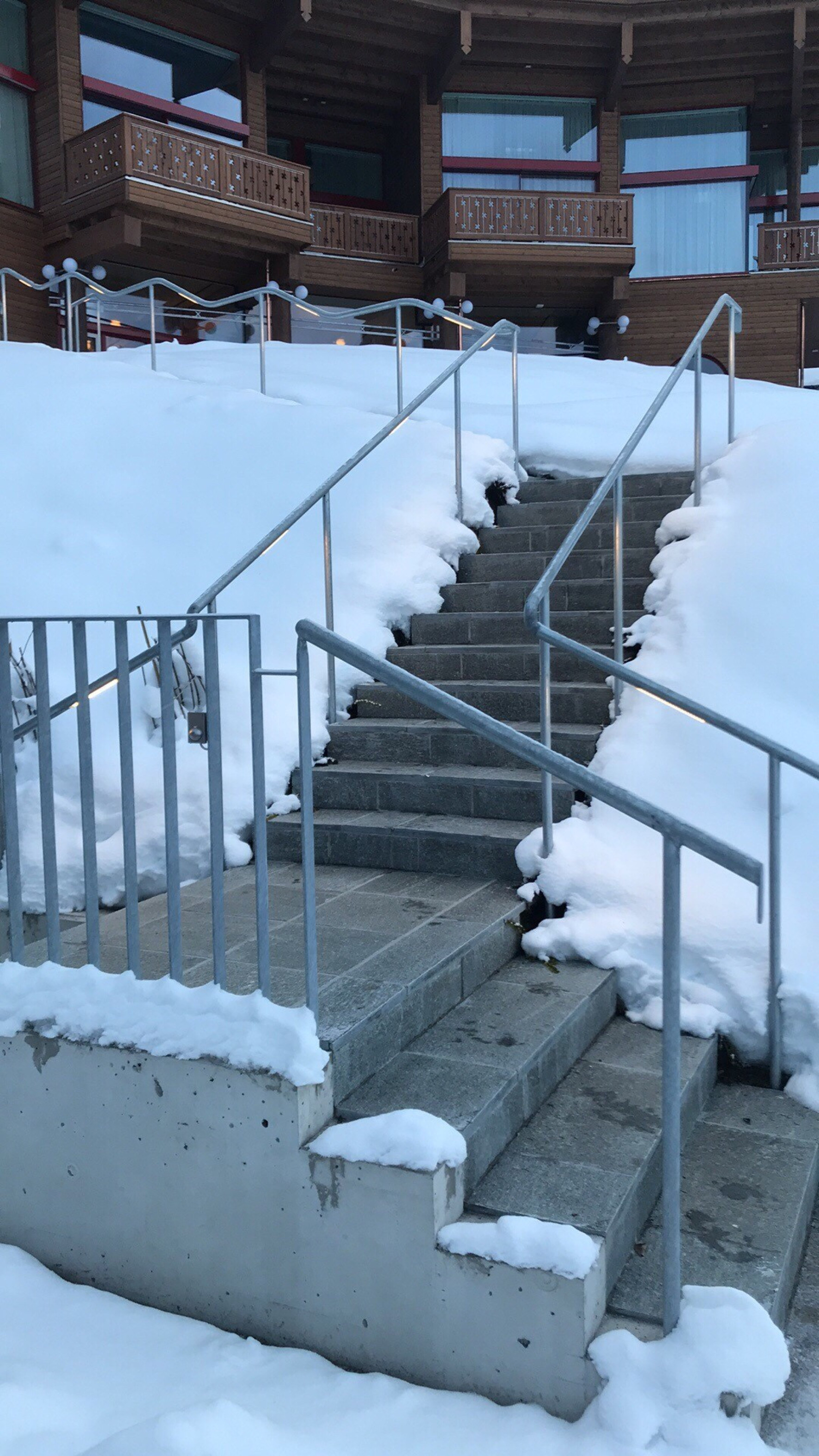
Stair treads have a high surface area-to-mass ratio. They lose heat from the top face, the riser face, and through the structure below. They are frequently shaded from solar gain by the building above them. And in manual de-icing operations, steps are often the last surface to receive treatment - because they are enclosed, awkward to access with gritting equipment, and quickly stripped of salt by foot traffic.
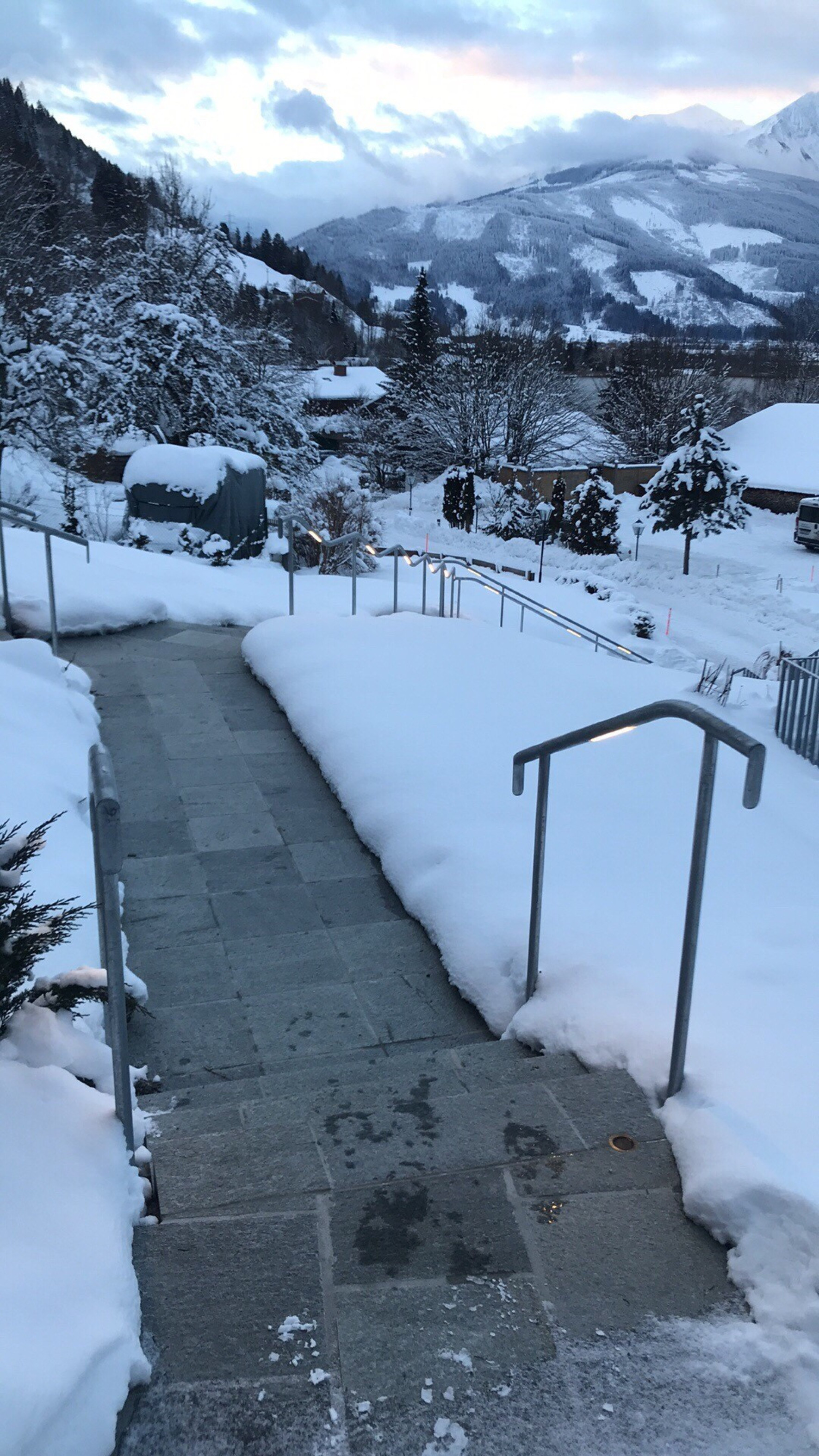
The result: stair treads ice earlier, more severely, and for longer than adjacent flat surfaces in the same conditions. In UK winters, this commonly means an iced entrance staircase at 08:00 when the surrounding driveway is still clear - and when the gritting team has not yet identified a problem.
Falls on steps are more severe than falls on flat surfaces. The step geometry creates a height differential - a person falling on stairs falls further and impacts at a different angle than on flat ground. HSE slip, trip, and fall data for commercial premises consistently reflects this: staircase incidents are disproportionate to the number of steps in service. The legal context under the Occupiers' Liability Act 1984 is clear: a foreseeable hazard that causes injury is a liability failure.
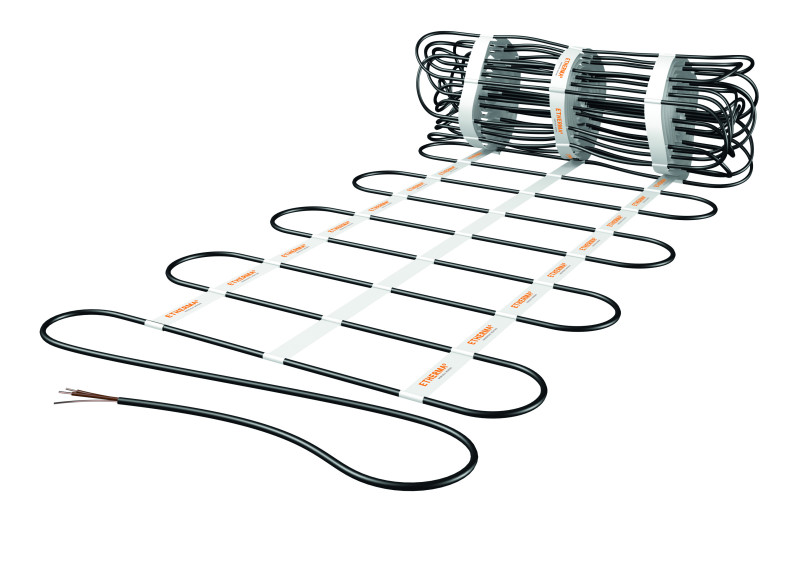
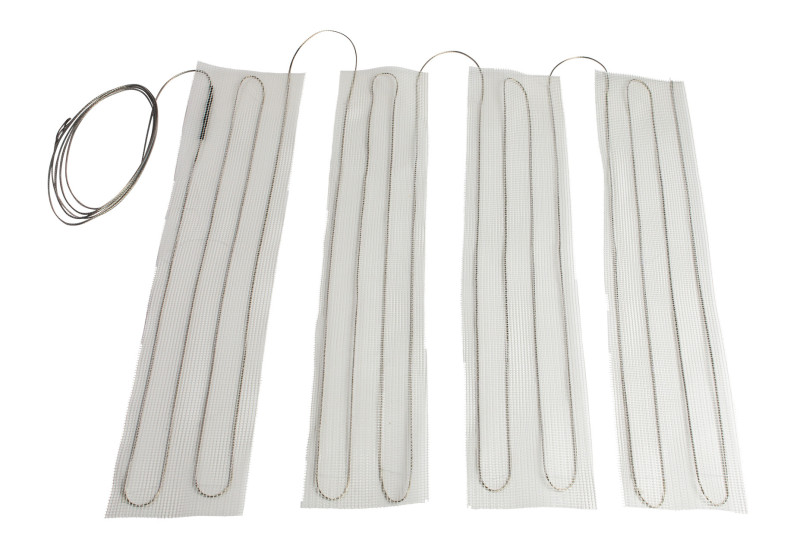
Custom-manufactured to the geometry of your stairs

Unlike flat surface heating mats, which can be sized to area, staircase heating requires a product manufactured to the exact dimensions of each tread and riser.

Both products in the ETHERMA stair heating range - BRS-TS and NSP-TS - are custom-made to project specification. No cutting on site. No compromised element layout.

The mat delivered to site is the mat specified for that exact stair.

An eFROST controller with surface temperature and moisture sensing activates the system automatically.

ARC provides the technical specification and the element layout design, and coordinates manufacture of the custom mats to the dimensions provided by survey.

New build or retrofit - the right system for your project


BRS-TS - New Build:

Concrete & Asphalt Stairs

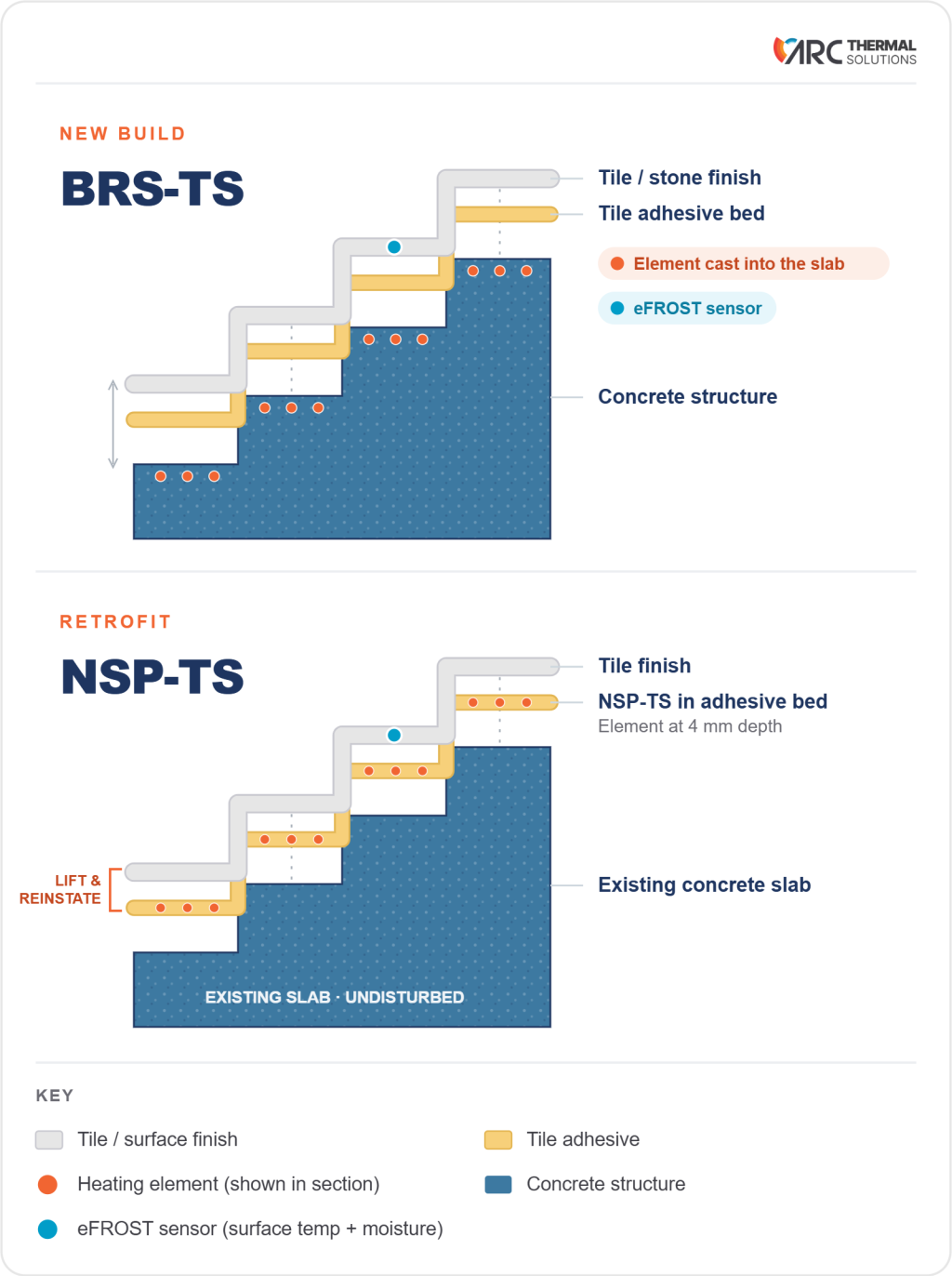
BRS-TS is the correct specification where staircase construction or reconstruction is planned: new build or full stair rebuild. The mat is embedded in the concrete or rolled asphalt structure at the pour or laying stage, at an installation depth of 8.5mm. Once embedded, the element is integral to the stair structure with no surface-visible components.

Power output: 250–350 W/m²

Installation stage: at concrete pour or asphalt laying

Substrate: Concrete / Rolled asphalt

Note: BRS-TS cannot be retrofitted without structural reconstruction of the stair. It is a new-build specification only.

NSP-TS - Retrofit & Tile/Slab/PU Finish Stairs

Custom-Made

NSP-TS is custom-manufactured to the exact dimensions of each tread - making it the correct solution for adding frost protection to existing stairs without structural alteration. Installed in the tile adhesive bed at just 4mm depth, NSP-TS is compatible with tile, natural stone, porcelain slab, and polyurethane rubber stair treads. The structural stair slab is not touched; only the surface finish is removed and reinstated.

Power output: 250–350 W/m²

Installation depth: 4mm (adhesive bed)

Substrate: Tile / Natural stone slab / Porcelain/ PU rubber treads

Key applications: Retrofit to existing stairs /New build with tile or stone finish /Listed building and conservation area installations where structural alteration is restricted

Note: NSP-TS is custom-manufactured. ARC will coordinate tread dimension survey, element design, and manufacture. Allow for lead time in project programme.

Where stair and entrance heating is specified

Hotel and hospitality entrance steps

prestige entrance requirement; manual salting is incompatible with a luxury guest-facing environment

Public building and civic entrance staircases

local authority duty of care; high footfall in adverse weather

School and university external staircases

School and university external staircases - duty of care for young people; high incident risk from running or rushing during peak times

Railway platform and station access stairs

high-frequency use during commuting hours in adverse weather

Commercial office building entrance platforms

employer duty of care for staff access

Hospital and healthcare facility access

patient and visitor mobility and safety; 24-hour use

Residential apartment block communal stairs

building management duty of care; frequently overlooked in frost risk assessments

What a correctly specified stair heating system delivers

Technical:

Custom-manufactured mats to exact stair dimensions -

no cutting on site, no compromised element layout across treads

NSP-TS at 4mm compatible

with retrofit applications without structural alteration to the stair slab

Operational:

Zero manual intervention -

no salting, no monitoring, no call-out during the early morning high-risk period

System activates

before staff arrive, before the hazard develops

Commercial:

Slip and fall on steps is a documented high-severity liability -

automatic frost protection is a more defensible position than recorded manual salting, which is subject to coverage gaps, delay, and documentation failures

Eliminates manual salting of entrance steps -

a material benefit for prestige buildings where salt residue and bucket equipment are incompatible with the entrance aesthetic

Yes - using NSP-TS, installed in the tile adhesive bed at 4mm depth. The process removes the existing tread surface finish, installs the custom-manufactured mat in the adhesive bed, and reinstates the surface finish with the same or replacement material. The structural stair slab is not disturbed. Staircase access is disrupted during installation, but typically for days rather than weeks. BRS-TS, by contrast, requires structural reconstruction and is a new-build specification.

NSP-TS is compatible with tile (ceramic, porcelain, quarry), natural stone slab, and polyurethane (PU) rubber stair treads - the most common commercial stair surface finishes for retrofit applications. Compatibility with specialist finishes should be confirmed with ARC at specification stage.

Via the eFROST control system - ET-9200F for standalone staircase installations, ET-9300 where stairs are integrated into a larger frost protection zone. The controller activates heating based on dual-parameter sensing (temperature + moisture) - running only under conditions where ice can form. With the ET-9380 WLAN module, system status is accessible remotely via the eFROST online portal.

Yes. NSP-TS is custom-manufactured to the exact dimensions of each tread - including wedge-shaped treads on spiral or curved stairs where standard rectangular mats cannot fit. ARC will conduct a dimensional survey and coordinate manufacture. Lead time for custom-shaped mats should be built into the project programme.

For a typical commercial entrance staircase of 10 treads, the installed load might be 1–2 kW. With eFROST dual-parameter control, this might activate for 150–300 hours per heating season - consuming 150–600 kWh per year. This is a modest energy cost relative to the liability exposure being managed and the alternative cost of a manual de-icing programme over the same period.

Get a Stair Heating Specification for Your Building

NSP-TS and BRS-TS mats are custom-manufactured to the exact dimensions of your stairs - which means the specification starts with a survey. ARC assesses your staircase, confirms the correct product, coordinates custom manufacture with ETHERMA, and manages installation end to end.